
Market Data
Ticker Is Not Identity: Building a Point-in-Time US Microcap Universe
What 10,131 Historical Listings and 3,839 SEC Identity Checks Revealed
Summarize this research with AI
Open the article in your preferred assistant with a ready-to-use summary prompt.
The prompt is also copied to your clipboard as a fallback if the provider does not prefill it automatically.
Key findings
- The 15-year discovery census contained 10,131 candidate listing episodes, including 4,425 delisted episodes (43.68%); these are not all independently verified permanent securities.
- Available market-cap evidence yielded 7,257 ever-observed sub-$500M candidates and 229 unknowns, producing a conservative 7,486-record pool, not day-by-day PIT membership.
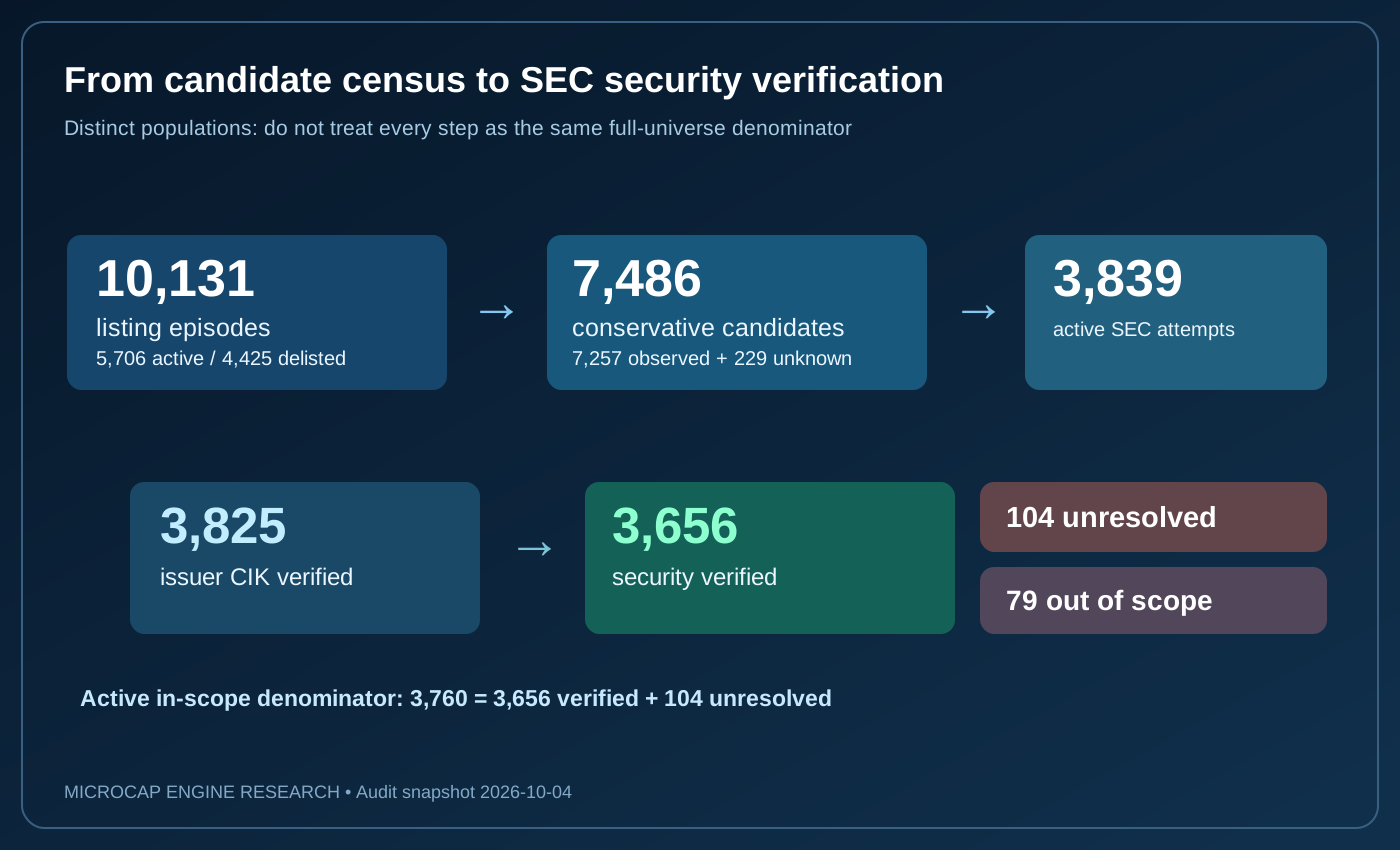
- A separate SEC audit attempted 3,839 active records: 3,825 issuer identities and 3,656 share-class-level security identities were verified.
- After excluding 79 out-of-scope instruments, 104 of 3,760 active in-scope records remained unresolved: 97.23% identity resolution coverage, not independently measured identification accuracy.
- Ticker strings and issuer CIKs are not permanent instrument identifiers; the SEC identity gate correctly remained INCOMPLETE despite zero structural integrity violations.
Core finding. A historical ticker is not a permanent security identifier. In our 15-year US microcap universe study, the difference between finding historical symbols and establishing verified, point-in-time security identities proved consequential: 10,131 candidate listing episodes narrowed to 7,486 conservative sub-$500M candidates, while a separate active SEC audit resolved 3,656 security identities and retained unresolved cases instead of guessing.
A stock backtest can be methodologically careful and still start with the wrong securities.
It may have realistic slippage, conservative fill assumptions, correctly adjusted indicators and separate in-sample and out-of-sample tests. Yet if a company that delisted in 2017 never entered the dataset, or a ticker that changed hands is associated with the wrong issuer's float, the strategy is not testing the intended historical opportunity set.
This is especially important for US microcaps. Corporate reorganizations, repeated financing, reverse splits, delistings, symbol changes and share-class complexity make it dangerous to assume that a ticker string is a stable key.
We investigated a specific research question:
How can a historical US sub-$500 million stock universe be discovered and verified without confusing current symbols, historical issuers and the actual securities that traded at the time?
Our answer was a staged process: discover active and delisted listing episodes, classify historical capitalization evidence, quarantine unsafe identity hints, verify SEC filers, verify registered share classes and admit only sufficiently supported identities.
The research produced meaningful coverage statistics, but it did not produce a claim of perfect historical completeness. This article separates what was actually measured from what remains unresolved.
Why a Historical Ticker List Is Not a Historical Universe
Imagine a trading strategy with three conditions: market capitalization below $500 million, unusually high relative volume, and a specified intraday price pattern.
The naive approach is to download today's ticker list, obtain several years of historical bars, attach whatever historical or current company data is available, and run the strategy.
The resulting backtest can be wrong in more than one way.
First, companies that no longer trade are absent from the current list. Second, companies that have a small market cap today were not necessarily small in the past. Third, the same ticker may have referred to another issuer or security at an earlier date.
This third problem is sometimes missed because the price history itself appears valid.
Consider a hypothetical symbol, ABCD. It represented Company Alpha several years ago. Alpha later delisted. Years afterward, unrelated Company Beta began trading under the same symbol. A database keyed permanently by the string ABCD might combine Alpha's old OHLCV with Beta's current shares outstanding and SEC disclosures.
Each vendor response might have been internally correct when requested. The joined analytical record would still be false.
A backtest could then display a precise float-rotation number, a market-cap filter and a filing catalyst for a combination of inputs that never belonged to one traded instrument.
The underlying question is not only whether the prices are real. It is whether all inputs belong to the same security at the relevant historical time.
Ticker, SEC CIK and Security ID Are Different Things
A useful equity research database needs to distinguish at least three identity layers.
| Identifier | Primary meaning | Sufficient by itself as a permanent security key? |
|---|---|---|
| Trading ticker | Symbol used for quotation, trading and lookup | No |
| SEC CIK | Filer associated with SEC EDGAR submissions | No |
| Permanent security identity | Specific evidence-backed traded instrument/share class | Yes, within its supported scope |
| Dated ticker alias | Relationship between a symbol and an already identified security over an interval | Useful for point-in-time lookup |
The ticker is an alias, not a timeless key
Tickers change after mergers, restructurings, naming changes and other corporate events. Symbols can later be assigned to unrelated issuers. A single ticker string is therefore not proof of continuous economic identity.
A symbol is still essential for practical trading. It just needs to be represented as an alias with the appropriate validity dates, rather than treated as the sole historical primary key.
The SEC CIK is a filer identity
The SEC assigns a Central Index Key, or CIK, to entities and individuals that submit EDGAR filings. CIK-based submissions data is a strong way to establish issuer-level filing history. SEC — CIK lookup · SEC — EDGAR APIs.
But a filer can have multiple registered securities. One CIK can be associated with common shares, additional common classes, depositary securities, preferred instruments, notes or other securities.
Therefore, a correct CIK-to-company match does not, by itself, identify the traded share class behind a given price series.
The permanent security must have instrument-level evidence
In our model, ticker and exchange are navigational data. An issuer ID establishes the filer; a permanent security ID additionally requires supported instrument-level evidence.
This is broadly consistent with the importance of permanent security identifiers in historical databases such as CRSP, which distinguishes permanent identifiers from changeable ticker references. CRSP — PERMNO.
The architectural goal is to represent two very different events correctly: one security changing its ticker, and one ticker being used by two different securities at different times.
The former may be one continuous security history. The latter must not be merged merely because the string matches.
What We Counted: Listing Episodes, Not Verified Securities
Our study window was October 4, 2011 through October 4, 2026.
The target exchanges were Nasdaq, NYSE and NYSE American, including historical AMEX aliases. The candidate universe was designed around US-listed primary-equity instruments that could have been below $500 million in historical market capitalization.
We began with Financial Modeling Prep's active screening and delisted-company inventories, together with the stock-list and historical-capitalization endpoints. FMP — Historical Market Cap.
The discovery stage normalized exchanges and applied deterministic filters for clear non-primary-equity instrument patterns, including certain warrants, rights, units, preferred securities and notes.
The raw inputs included 6,079 active screener records and 15,683 delisted-source records that met the source date filter. These numbers are raw discovery feeds, not a sum of unique common-stock securities.
After candidate filtering and deduplication, we obtained 10,131 listing episodes involving 10,119 distinct ticker strings.
A listing episode is a record describing a candidate symbol, issuer-name context, exchange and available listing dates. At this stage it is not yet a confirmed permanent security identity.
That distinction prevents the discovery statistics from being misrepresented as a complete verified stock universe.
Why Delisted Stocks Change the Starting Population
Our initial 10,131-episode census contained:
| Candidate episode status | Count | Share |
|---|---|---|
| Active | 5,706 | 56.32% |
| Delisted | 4,425 | 43.68% |
| Total | 10,131 | 100% |
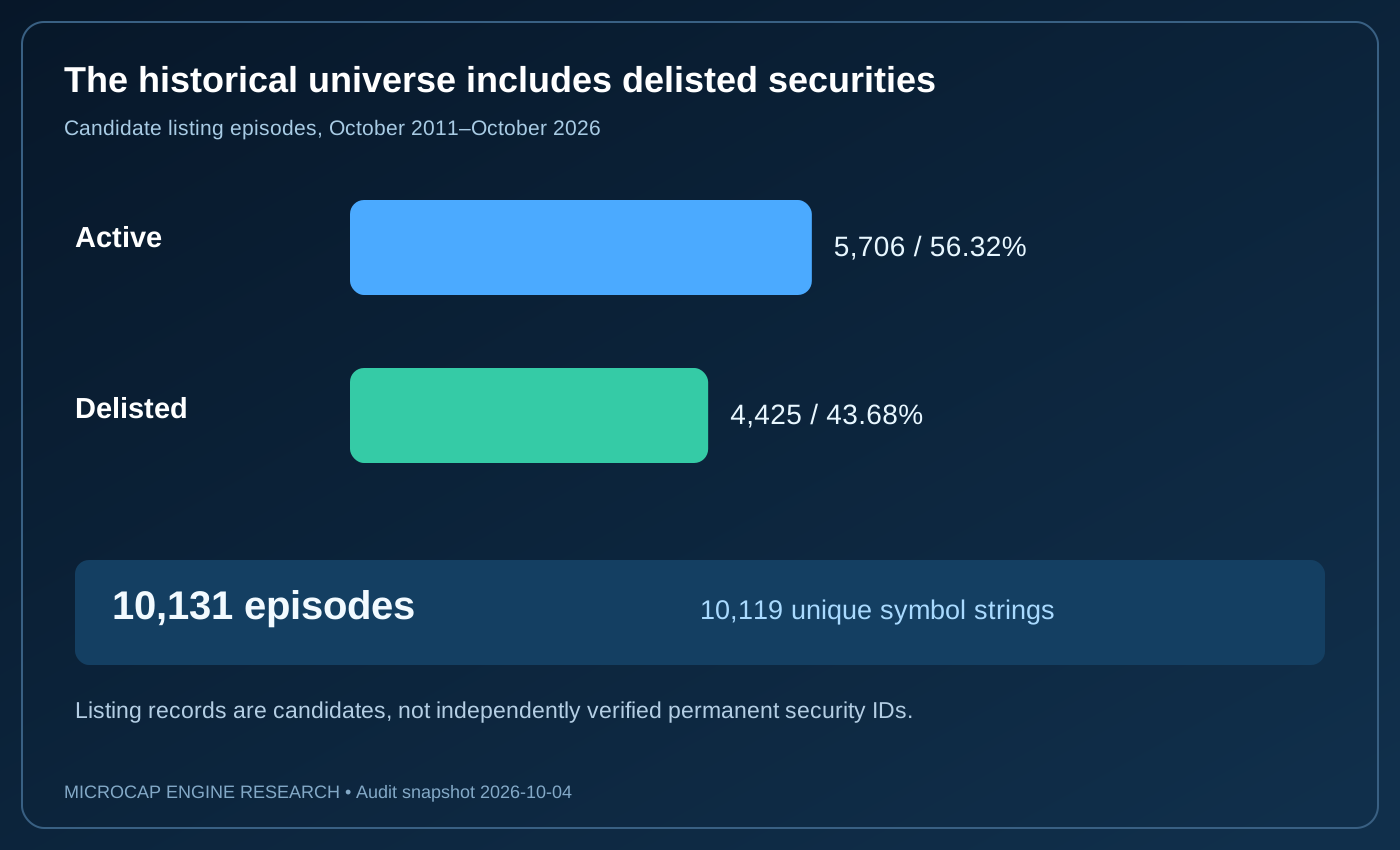
The important finding is the size of the historical population missing from a current-only screening approach.
4,425 candidate episodes were already marked delisted. A historical experiment that begins only from today's active ticker inventory would not reconstruct those records merely by downloading longer histories for the surviving names.
However, 43.68% is not a bankruptcy rate, a measured probability of delisting, or a general estimate for all microcap companies.
The delisted label can arise from acquisitions, mergers, privatizations, exchange transfers, restructurings, liquidations or listing failures. Our result is the composition of a source-defined discovery census under our filtering rules.
A further caution: the numerical difference between 10,131 episodes and 10,119 ticker strings does not establish the number of ticker-recycling events. Multiple episodes can exist for other reasons. Confirming reuse requires actual security-level chronology.
This is an important general principle: a large historical listing count is evidence of a broad discovery inventory, not automatically evidence of a historically correct security mapping.
Historical Market Cap: 7,257 Qualifiers and 229 Unknowns
The next question was which discovery episodes could have belonged to the sub-$500M population.
Current market cap is not sufficient for this.
A company that is worth $2 billion today may have traded below $500 million years earlier. Another company worth $90 million today may have spent years above the ceiling.
Our classification examined valid observed market caps within the available episode period. For active candidates, a qualifying current capitalization could also establish entry into the broad discovery pool.
The rule was ever observed below $500 million, not below $500 million every day.
The measured capitalization-screening results
| Market-cap evidence category | Episodes | Share of 10,131 |
|---|---|---|
| At least one valid observed capitalization below $500M | 7,257 | 71.63% |
| Valid history with no observed qualifying capitalization | 2,645 | 26.11% |
| Insufficient valid capitalization history | 229 | 2.26% |
| Total | 10,131 | 100% |
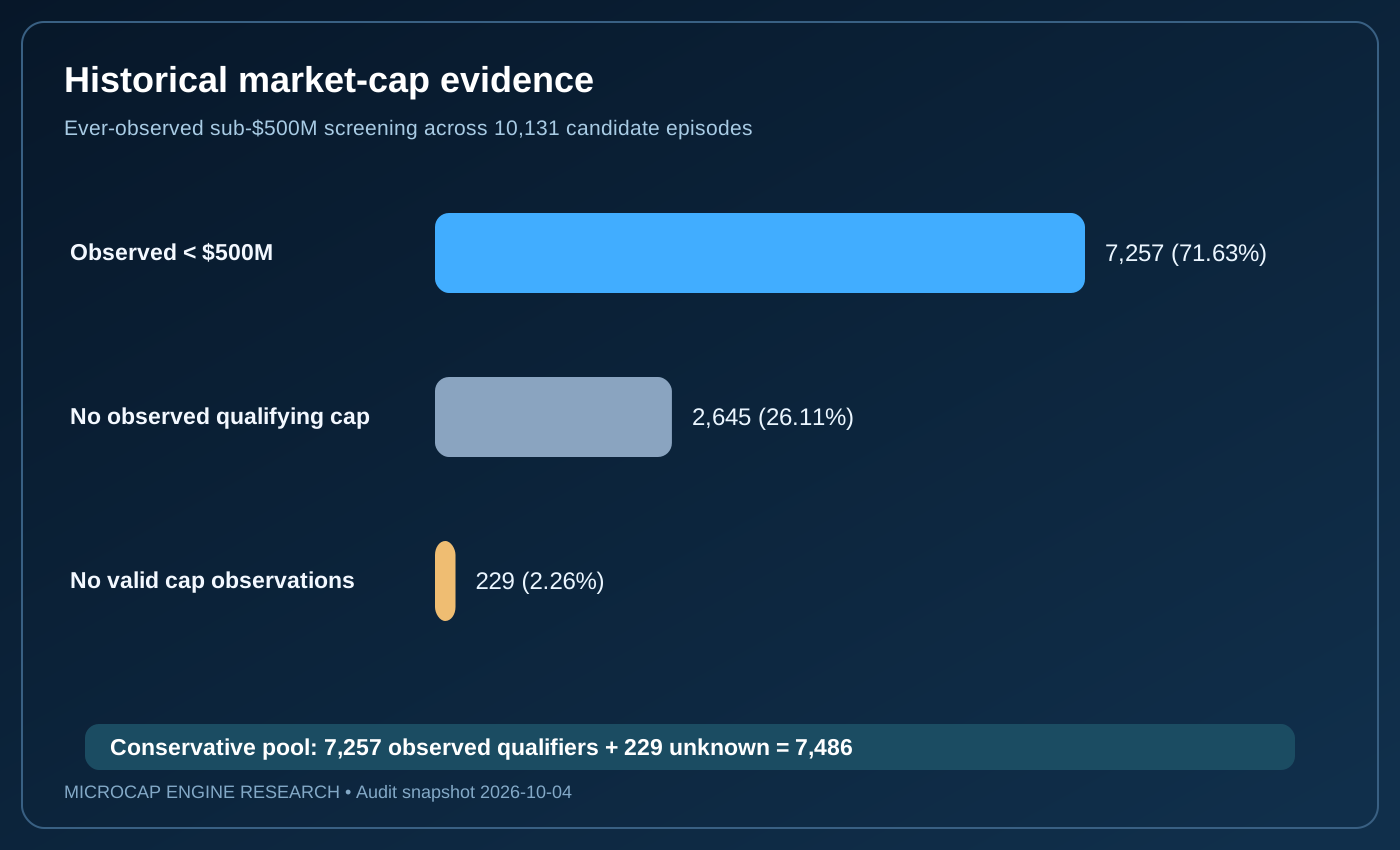
The conservative candidate pool was therefore 7,486 episodes:
7,257 observed qualifiers + 229 insufficient-history records = 7,486.
The 229 unknowns were intentionally retained for further investigation rather than interpreted as false.
Equally, a record in the 2,645 no-observed-qualifier group was not proved to have never crossed below $500 million. The available valid observations did not show it doing so. Unobserved intervals remain a limitation.
These distinctions matter because historical market-cap histories are finite observations with their own coverage limits.
Why a missing value must not become zero or false
A missing historical capitalization can mean missing source coverage, missing share-count history, an unsupported security, a period mismatch or another problem. It does not inherently mean zero market cap, nor does it prove the security was over the threshold.
If unknown records are removed without being counted, the universe becomes narrower but not necessarily more accurate.
Our decision was to retain unknowns in the conservative discovery population while preventing them from receiving unsupported production eligibility.
This preserves both analytical caution and audit visibility.
Ever-Qualified Is Not Point-in-Time Eligible
Candidate discovery answers whether a listing episode could have been relevant during the study.
A live scanner or historical backtest must answer a different question: was this particular security eligible at this particular decision time?
Consider an illustrative market-cap timeline:
| Date | Observed capitalization | Below $500M? |
|---|---|---|
| January 2018 | $740M | No |
| June 2018 | $420M | Yes |
| November 2018 | $180M | Yes |
| April 2019 | $610M | No |
This example is hypothetical and does not represent an additional measured ticker case.
The episode belongs in an ever-qualified candidate pool because June and November are below the threshold. A backtest must not treat January and April as eligible merely because the episode appears in that pool.
There is also a second point-in-time issue: the date attached to a historical capitalization value does not automatically establish when the information used to calculate it became available. Share counts can be disclosed later or revised by subsequent filings.
A sound implementation therefore distinguishes:
- Discovery membership: inclusion in a broad historical inventory.
- Instrument identity: which exact issuer and share class produced the market record.
- Effective valuation state: which market-cap and share-count values apply to the historical date.
- Information availability: when the relevant inputs were knowable.
The research described here measured candidate discovery and an active identity-audit subset. It did not certify a complete daily point-in-time capitalization history for every candidate.
Why We Refused to Trust Provider CIK Hints Automatically
Company-reference APIs often provide ticker, name, exchange and a CIK.
These fields are valuable for narrowing search candidates. But a present-day CIK attached to a present-day ticker does not automatically identify the issuer that used the same symbol many years earlier.
Imagine a delisted episode recorded under ABCD in 2016. A current lookup for ABCD in 2026 could return a valid CIK for a completely different issuer.
If the system promotes that current CIK directly into the 2016 record, later SEC and share-count joins can be wrong while still passing ordinary formatting checks.
Our identity-sanitization stage therefore processed all 7,486 conservative candidates and kept unverified provider identities in an unresolved state rather than treating the hints as canonical keys.
The sanitization audit found zero structural integrity issues. That did not mean the 7,486 identities were verified; it meant the process respected its explicit safety invariants.
Before authoritative verification, production-eligible identity count was zero. This was a deliberate fail-closed state.
The desired workflow is to use provider fields to find potential evidence, then let verified evidence determine whether a permanent issuer or security identity can be assigned.
SEC Verification Stage One: Who Is the Issuer?
We then ran a separate SEC identity audit on the selected active candidate subset, using an October 4, 2026, 23:59:59 UTC cutoff.
The verifier compared ticker and candidate CIK information against authoritative SEC ticker/submissions data. It could accept a candidate issuer only when the available SEC evidence supported the association.
Of 3,839 active attempted records, 3,825 passed issuer verification.
That is an issuer-verification coverage rate of 99.64% of attempted active records.
The other 14 did not obtain the required current SEC ticker candidate in this run.
This is a strong indication that SEC submissions data can resolve many active issuer relationships under the tested rules.
It is not evidence that all delisted records were verified, and it is not the final security-identity result.
Knowing which issuer filed with the SEC still leaves the instrument-level question open.
SEC Verification Stage Two: Which Share Class Traded?
For security identity, the resolver examined SEC filing cover pages, including Inline XBRL fields representing registered security title, trading symbol and exchange.
The system attempted to associate the expected symbol with a qualifying instrument class, rather than simply accepting any listed instrument under the same CIK.
A verified security needed an unambiguous registered-security relationship.
A filing might identify a common share class alongside warrants, notes and units. Some classes could be excluded confidently, while others could remain unresolved if the available title was not adequate for deterministic classification.
This prevents a subtle error: labeling something a verified stock when the SEC evidence only establishes that an instrument with the same issuer exists.
Which forms supplied successful evidence?
The audit examined 4,337 candidate SEC cover filings in its resolution process.
The 3,656 successful security resolutions were distributed as follows:
| SEC filing family | Successful security resolutions |
|---|---|
| 10-Q / 10-Q/A | 2,710 |
| 20-F / 20-F/A | 688 |
| 10-K / 10-K/A | 138 |
| 40-F / 40-F/A | 77 |
| 8-K / 8-K/A | 43 |
| Total | 3,656 |
These are successful verifier outcomes by filing family, not a representative distribution of all SEC filings.
It is particularly notable that annual reports were not the only useful sources. Quarterly and foreign-issuer filings supplied much of the instrument-level evidence in this selected audit.
SEC Identity Results: 3,656 Verified and 104 Unresolved
The decisive audit output separated three statuses:
| Active audit outcome | Records |
|---|---|
| Security identity verified | 3,656 |
| Active in-scope identity unresolved | 104 |
| Confirmed out-of-scope instruments | 79 |
| All active records attempted | 3,839 |
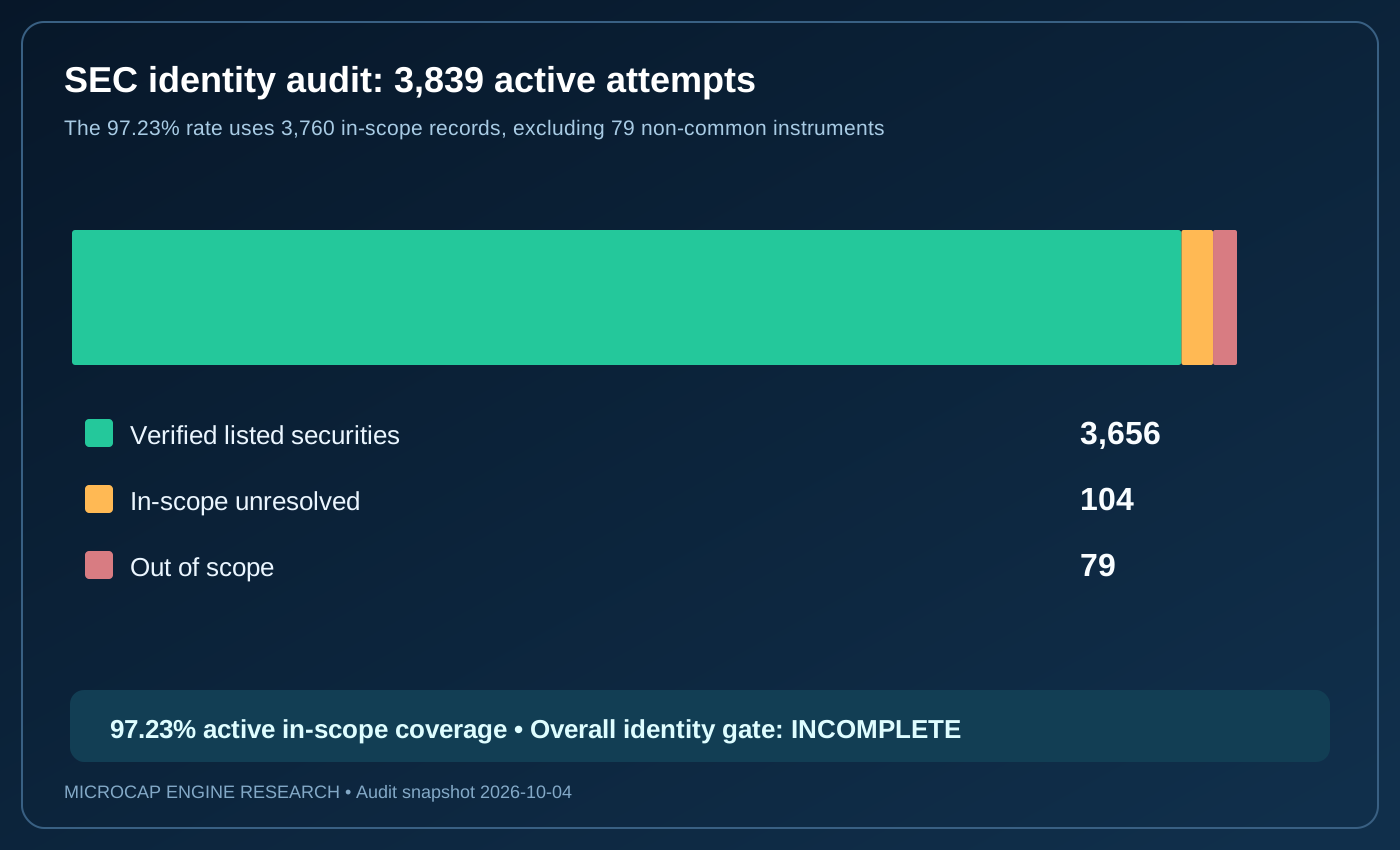
Once the 79 out-of-scope instruments were removed, the active in-scope population was 3,760.
That means 3,656 / 3,760 = 97.23% of active in-scope records reached a verified security identity under the selected rules.
The rate is best described as identity resolution coverage, not externally verified mapping accuracy.
The audit also reported 104 unresolved in-scope records, which means the overall active identity gate remained INCOMPLETE.
It would be incorrect to announce that the entire historical 7,486-record pool was 97.23% identity verified. The denominator for that percentage is the separate 3,760-record active in-scope audit subset.
The difference is fundamental to interpreting this research.
The Unresolved Cases Exposed Distinct Failure Modes
Why did the remaining records fail to resolve?
The audit reported the following issue categories.
| Diagnostic category | Occurrences | Meaning |
|---|---|---|
| SEC cover ticker not found | 74 | The examined filing evidence did not establish the expected ticker match |
| SEC current ticker not found | 14 | The initial current SEC ticker candidate was absent |
| SEC cover share class unsupported | 11 | The security title did not support safe class resolution |
| No suitable PIT cover candidates | 5 | No acceptable dated evidence candidate was found |
| SEC cover ticker ambiguous | 3 | The available matches were not sufficiently unique |
Issue counts can overlap. Their 107 total occurrences correspond to 104 distinct unresolved records; they are not mutually exclusive rows.
A missing cover ticker is not equivalent to proof that the ticker did not exist. The chosen filing may lack suitable structured tags, the symbol may have changed, or more evidence may be needed.
Likewise, an ambiguous share class is not resolved simply because the issuer is known. Two distinct instruments can exist under one CIK, and choosing the first matching title would add unsupported certainty.
The audit makes these situations explicit rather than treating all failures as one generic error.
This is useful both for remediation and for downstream research: a reader can tell whether a record was out of scope, unresolved because of missing evidence, or accepted.
Why 79 Apparent Equity Candidates Were Out of Scope
The SEC verification step confirmed 79 active records as non-target instruments after they had survived initial discovery and reference-data filters.
The observed out-of-scope title categories included subordinated notes, preferred classes, units, capital-trust instruments and other non-common securities.
These records were not necessarily fake or erroneous market-data records. They simply did not belong to our intended primary common-equity universe.
For example, a listed warrant can have valid prices and trading volume, but its market structure, economic payoff and relevant outstanding quantity differ from the issuer's common shares. A strategy trained on common-stock features should not silently mix the warrant into the same population.
The two-stage design therefore serves a practical purpose:
Initial symbol/name/security-type filtering removes clear cases efficiently. SEC evidence then helps settle difficult cases and reveal residual contamination.
A valid price history can still belong to the wrong asset class for the strategy being tested.
Ticker Reuse: The Same Symbol, Two Different Securities
The most dangerous join is one that silently treats reused ticker text as continuous security identity.
In the illustrative case below, ABCD identifies Company Alpha's Security A from 2014 to 2017, and later Company Beta's Security B from 2023 to 2026.
This is a hypothetical example of the mechanism, not a counted real-world ticker-reuse event from the audit.
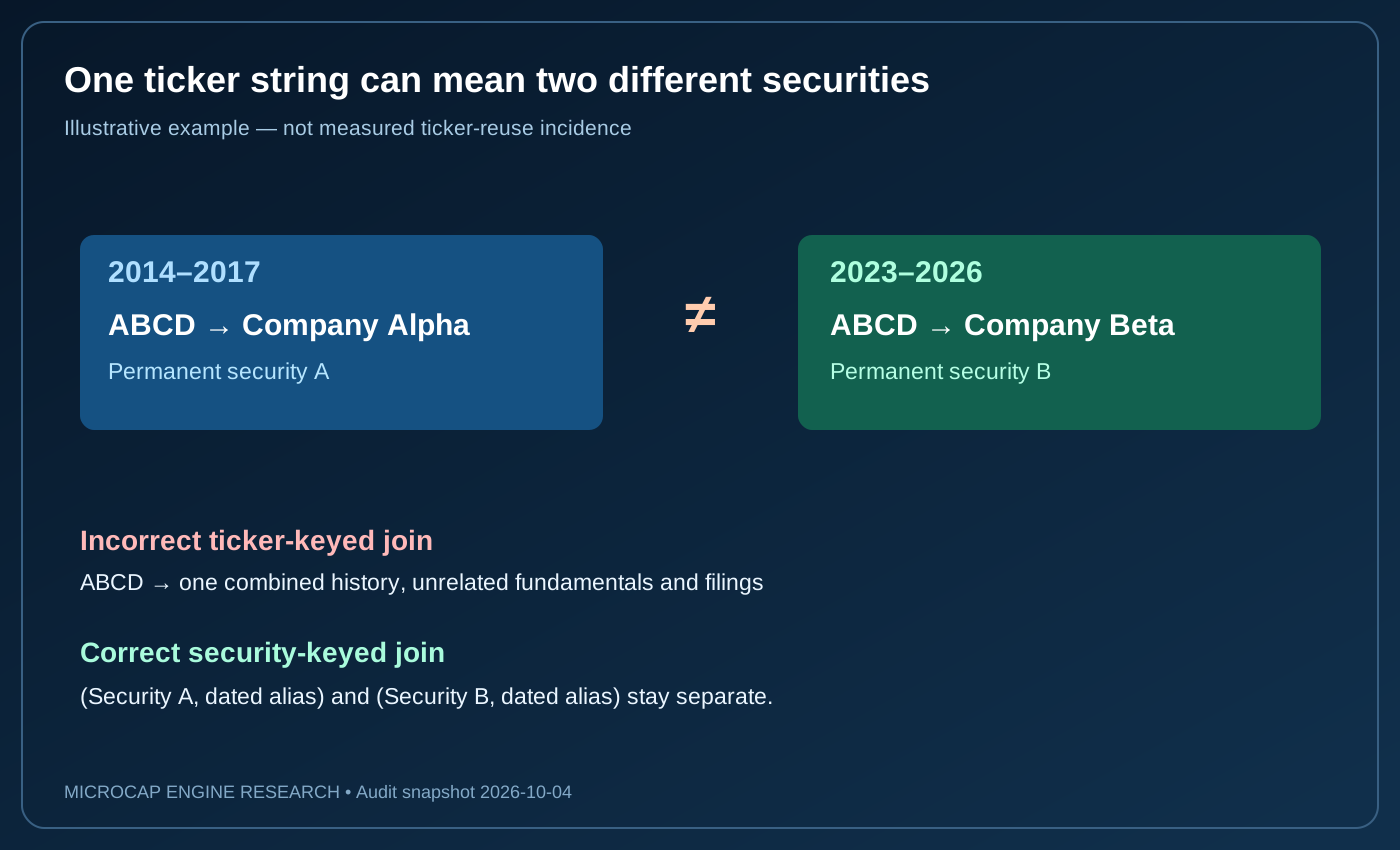
A ticker-keyed database can accidentally assemble one ABCD price series and attach current metadata to all of it.
An identity-aware database instead stores two security records and two separately dated ticker aliases.
That also handles the reverse situation: a company can change its ticker while the underlying security continues. In that case, blindly splitting the history at the symbol change may be just as wrong as joining two unrelated issuers.
The correct behavior depends on evidence of the actual listed instrument and its continuity, not just a string comparison.
Why name matching is not enough
Company names can change, be similar across issuers or be affected by mergers and successor entities. A fuzzy company-name match is useful for proposing candidates, not for granting permanent identity.
Our internal security model therefore uses supported issuer identity plus an authoritative security-level key to derive a stable identifier independent of the ticker.
A dated alias points to that existing security identity; it cannot establish one by itself.
What Makes an Identity Point-in-Time?
A historical identity record needs chronology as well as a stable identifier.
We distinguish when an event or alias is effective from when the supporting evidence was known.
Suppose a company announces on Monday that its ticker will change on Thursday. The information exists Monday, but the old symbol may remain the trading alias until the effective date.
Conversely, a later SEC report can describe an event that took place earlier without establishing that the later document was available at the original time.
A time-safe identity resolver must apply evidence only when its known-at and effective-at constraints are satisfied, and stop using an alias after any applicable validity end.
This is different from overwriting every old record with today's ticker.
The October 2026 SEC identity audit validated a selected active population at a specific cutoff; it did not independently prove every symbol-to-security interval back to 2011, especially for delisted episodes.
That historical alias-completeness question remains separate and cannot be inferred from the active identity resolution rate.
Why This Matters for Market Cap, Float and Relative Volume
Identity contamination is not only a naming inconvenience.
Market capitalization combines security prices and the correct issuer/share-class share counts. If the price belongs to Company Alpha and the shares outstanding belong to Company Beta, the capitalization is not a historical measurement of either.
Float rotation is typically traded volume divided by free-float shares. The numerator and denominator must refer to a compatible security and historical state. A wrong float can create a dramatic-looking ratio that never existed in the actual market.
Relative volume compares activity with earlier sessions. A symbol-reuse boundary inside the lookback can combine unrelated securities and create a false baseline.
Corporate actions such as reverse splits must be applied to the correct security history. Shared symbol text is insufficient grounds for applying another issuer's split factors or share-count changes.
SEC dilution research requires the correct issuer and instrument. Looking up filings through today's ticker can accidentally retrieve a newer company's ATM agreement, preferred shares or warrants when analyzing an older security.
Backtest optimization can then amplify these errors. A strategy optimizer may prefer invalid candidates because the contaminated features appear predictive. More walk-forward folds will not fix a mislabeled instrument.
Identity validation therefore belongs upstream of feature generation and strategy optimization.
Survivorship Bias Is Only One Universe-Construction Problem
Including the delisted population helps address current-listing survivorship bias, but several other failure modes remain:
- Universe coverage bias. Historical listing inventories themselves may be incomplete or inconsistent across years and exchanges.
- Ticker continuity error. A symbol may be incorrectly reused as a permanent key, merging different issuers.
- Instrument-type contamination. Warrants, notes, units or preferred instruments may enter a common-equity universe.
- Future-data leakage. Current company data, later share counts or future issuer associations may be used for old decisions.
- Missingness selection. Unresolved records may be silently dropped even though complex or delisted issuers could have different market behavior.
These failure modes are logically separate.
A historical database can include delisted symbols and still be contaminated by wrong SEC joins. It can have correct issuer CIKs and still confuse common stock with a preferred class. It can have perfect symbol mapping today and still lack dated historical aliases.
The solution is not one special filter. It is a chain of evidence-backed classifications with explicit failure states.
Our Practical Historical-Universe Validation Pipeline
| Stage | Main task | What its output establishes |
|---|---|---|
| 1 — Listing discovery | Combine active and delisted source records | Candidate episodes and provenance |
| 2 — Instrument prefilter | Apply deterministic exchange and security-type rules | Initial in-scope candidates |
| 3 — Historical capitalization | Evaluate observed market caps in episode bounds | Observed qualifier, no observed qualifier, or unknown |
| 4 — Identity sanitization | Remove unsupported canonical IDs | Provider values remain lookup hints |
| 5 — SEC issuer verification | Confirm filer association | Verified issuer CIK |
| 6 — SEC cover verification | Match registered security title, ticker and class | Verified instrument or explicit unresolved/exclusion |
| 7 — Security identifier | Derive stable ID from issuer + security evidence | Identity independent of ticker text |
| 8 — Eligibility gate | Combine identity, instrument scope and cap qualification | Supported records only |
| 9 — Historical alias/PIT layer | Date-effective symbol, price, actions and financial state | Required for full point-in-time replay |
Stages one through eight produced the audit measurements described here within their respective populations. The historical alias and strict daily eligibility layer is a broader completeness requirement; this paper does not claim it is finished for every candidate.
A passing integrity check is not full coverage
The selected SEC identity run reported zero identity-integrity issues while simultaneously reporting INCOMPLETE for the overall identity gate.
There is no contradiction.
Integrity checks whether records violate defined constraints — such as a production-eligible security with no security ID, or an out-of-scope security admitted as ordinary common equity.
Completeness asks whether all intended securities have been successfully resolved.
The audit could satisfy its structural checks and still correctly retain 104 unresolved active in-scope records.
A dataset that reports only zero errors without its unresolved denominator could be substantially more misleading than one that openly states which cases remain unknown.
Public Aggregated Audit Dataset
To make the primary numerical findings reusable and independently checkable, we provide the stage-level aggregated audit outputs.
The files disclose discovery totals, market-cap classifications, issuer and security verification outcomes, filing-family counts, issue labels, data-scope descriptions and limits.
They do not expose underlying ticker-to-CIK mapping records, paid-provider datasets, raw filings, individual issuer histories or API credentials.
Important denominator note: 10,131 is the discovery population; 7,486 is the conservative capitalization candidate pool; 3,839 is a separate active SEC audit subset; 3,760 is the active in-scope subset after 79 out-of-scope exclusions. These are not interchangeable denominators.
The unresolved issue counts are occurrences and can overlap. The published CSV records that qualification so category totals are not misread as disjoint case counts.
What Our Research Establishes — and What It Does Not
The measured data establishes that:
- Our source-defined historical discovery census identified 10,131 episodes, including 4,425 delisted episodes.
- Historical capitalization observations supported 7,257 ever-observed sub-$500M candidates, with 229 additional unknowns retained in the conservative pool.
- The active SEC audit verified 3,825 issuer-level associations among 3,839 attempted records.
- It then resolved 3,656 security-level identities and identified 79 out-of-scope instruments.
- The remaining 104 unresolved active in-scope records were preserved rather than force-matched.
These results do not prove that the complete 15-year historical universe has been mapped; that all delisted identities are verified; that every historical capitalization was usable at each intraday decision time; that resolved mappings have 100% independently adjudicated accuracy; or that a specific trading-return improvement has already been measured.
We believe this is the necessary distinction between an honest data-validation report and a headline completion percentage.
Why Microcap Engine Is Building Around Security Identity
Microcap Engine's research, scanning and backtesting tools need coherent underlying instruments.
Our separate raw SIP-to-OHLCV research investigates which market events should form chart-ready historical candles. This article addresses a different prerequisite: which security those candles belong to.
The same security identity must also govern market capitalization, float, corporate actions, company filings and historical universe membership.
If each module performs a fresh current-ticker lookup independently, it can reach different answers about the same historical record. That is precisely what a shared evidence-based identity layer is intended to prevent.
The result is a general rule for research-grade historical systems:
Do not promote a historical symbol-to-security relationship beyond the evidence that supports it.
For microcap traders, this is not just a database concern. It is part of deciding whether a historical setup, scanner signal or measured strategy edge was based on a security that could actually have been identified and traded in that form.
FAQ
What is survivorship bias in stock backtesting?
It is a selection error that arises when a historical strategy uses a later survivor list to decide which securities existed in the past. Testing a 2015 strategy using only tickers active in 2026 omits names that disappeared along the way.
Does adding delisted stocks eliminate survivorship bias?
No. It improves historical population coverage, but ticker reuse, share-class ambiguity, missing delisted identifiers, present-day company data and incorrect point-in-time valuation states can still invalidate historical membership.
Can a ticker symbol be reused by another company?
Yes. A ticker is not guaranteed to represent one security indefinitely. Historical security IDs and dated alias relationships are needed to distinguish reuse from a mere ticker change.
Is an SEC CIK the same as a stock identifier?
No. A CIK identifies an EDGAR filer. A filer may have multiple registered instruments. The specific traded common share or class requires additional evidence.
What is the difference between issuer identity and security identity?
Issuer identity establishes the filer or legal entity. Security identity establishes the particular financial instrument or share class. One verified CIK does not resolve every instrument registered by that issuer.
What does the 97.23% verification rate mean?
It is 3,656 verified security identities divided by 3,760 active in-scope audit records. It measures identity resolution coverage under the SEC verifier's rules, not separately adjudicated mapping accuracy.
How many historical delisted episodes were found?
The initial discovery census contained 4,425 candidate delisted listing episodes out of 10,131. That share is not a bankruptcy rate, nor proof that the complete historical delisted population has been verified.
Why were 79 records excluded after initial screening?
SEC cover evidence classified them as out-of-scope non-common instruments, such as preferred securities, notes or units. A listed instrument can have genuine trades without belonging to a common-equity backtest universe.
Why did the audit have 104 unresolved records?
Some cases lacked an unambiguous SEC cover ticker, a suitable current ticker association, a supported share-class title or available dated evidence. The report exposes those issues instead of automatically choosing a provider match.
Why do the unresolved-issue counts add to 107 rather than 104?
The issue table counts diagnostic occurrences, while 104 is the number of distinct unresolved records. One record can carry multiple issues.
Can today's market cap be used to filter a historical strategy?
Not as a replacement for dated historical eligibility. Our discovery used observed historical capitalization to find candidates, but a backtest must evaluate whether the instrument qualified using information available at the historical decision time.
Does zero integrity errors mean the universe is complete?
No. The audit's structural integrity checks passed, while 104 active in-scope records remained unresolved and the overall gate was INCOMPLETE. Structural consistency and population completeness are separate metrics.
Is the audit dataset available to download?
Yes. We publish aggregate JSON results and stage-level CSV metrics. The files preserve the audit scope and limits; they are not full security-level historical mapping datasets.
Methodology and Scope Note
This research covers October 4, 2011 to October 4, 2026, and the selected SEC identity audit uses an October 4, 2026 23:59:59 UTC as-of cutoff.
The target exchange scope is Nasdaq, NYSE and NYSE American, with a historical market-cap ceiling below $500 million. Discovery used Financial Modeling Prep active, delisted and historical-capitalization data. Issuer and share-class verification used SEC ticker, submissions and registered-security cover-page evidence.
Version identifiers for the reported runs are fmp-microcap-universe-discovery-v1, fmp-microcap-market-cap-classification-v1, pit-universe-identity-sanitized-v1 and pit-universe-sec-identity-v3.
The primary research populations differ by stage:
- 10,131 candidate listing episodes at discovery.
- 7,486 conservative candidates after capitalization evidence screening.
- 3,839 selected active records attempted in the SEC identity audit.
- 3,760 active records in scope after 79 non-common exclusions.
Issuer verification is not security verification. Active SEC resolution coverage is not independent classification accuracy. Observed capitalization eligibility is not full strict point-in-time membership. Candidate delisted coverage is not a completed delisted-security identity ledger.
All percentages, counts and issue labels are descriptive observations of the selected audit runs; no causal trading-performance improvement is asserted.
Selected Public References
- U.S. SEC — EDGAR Application Programming Interfaces
- U.S. SEC — Look Up a Central Index Key (CIK) Number
- U.S. SEC — Accessing EDGAR Data
- Financial Modeling Prep — Historical Market Cap API
- Financial Modeling Prep — Delisted Companies API
- CRSP — Permanent security identifiers and PERMNO
- Microcap Engine Research — From Raw SIP Trades to Clean, Chart-Ready OHLCV Candles
- Microcap Engine Research — How We Built a Data-Backed Microcap Premarket Watchlist