
Market Data
Reconstructing Nasdaq Short Sale Restriction From Raw Trades — and Validating It Against Official Nasdaq Data
The 90% Reference, Trade Eligibility, Sparse Stocks and a 400-Case Historical Validation
Summarize this research with AI
Open the article in your preferred assistant with a ready-to-use summary prompt.
The prompt is also copied to your clipboard as a fallback if the provider does not prefill it automatically.
Key findings
- 200 of 200 selected official Nasdaq positive SSR triggers were reconstructed to the same second using Massive raw trades, Nasdaq reference-price rules and UTP Last-eligible conditions.
- 199 of 200 challenging Nasdaq official-negative ticker-days were correctly rejected; one official-versus-derived discrepancy remained unresolved.
- Our Rule 4763(c)(2) sparse-stock correction passed all 16 targeted controls after an earlier broad fallback caused 15 regressions by confusing actual Nasdaq trading with Update-Last eligibility.
- Six previously unresolved historical cases were reconciled to the official Nasdaq second after improving reference and eligibility logic.
- Official Nasdaq adjusted NOCP, Rule 4763 trading-history fallback, UTP SIP-time Last-sale semantics, symbol-opening gates and authoritative Reg SHO A/V status are distinct data layers.
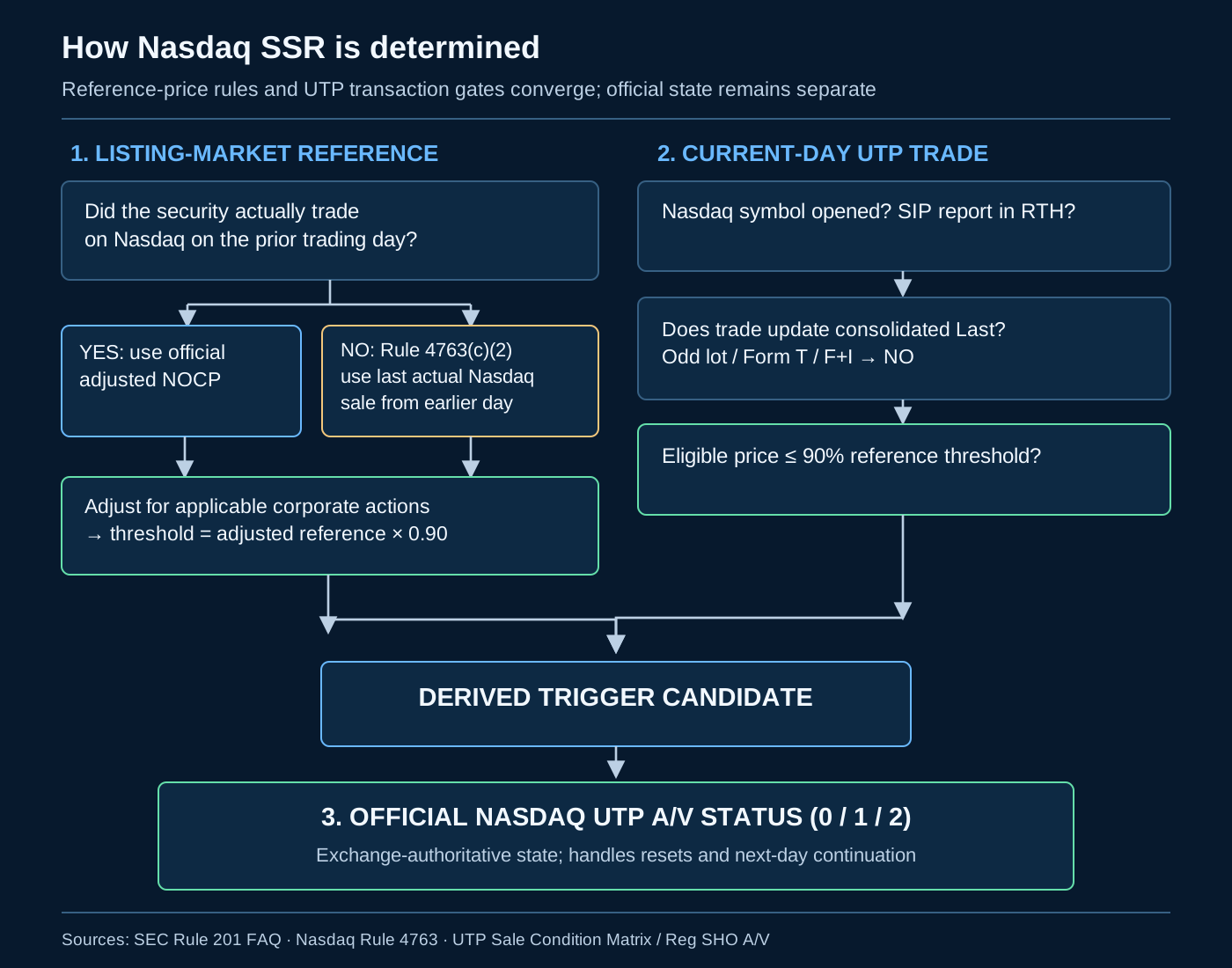
Core idea. Nasdaq Short Sale Restriction is not simply a 10% decline shown on a chart. The listing market determines the reference price, the consolidated UTP trade tape determines whether a transaction was eligible to trigger Rule 201, and official Nasdaq Reg SHO status controls when the restriction is in effect. We reconstructed these layers from Massive raw trades and compared the results with Nasdaq's own dated shorthalts files: 200 of 200 selected official positive events matched to the same second, and 199 of 200 difficult official-negative cases were correctly rejected.
A microcap stock can print a low more than 10% below yesterday's chart close and still not trigger SSR at the time a simple candle-based detector would suggest. A different stock can trigger based on a consolidated last-sale-eligible report from another exchange, rather than an execution on Nasdaq itself.
A backtest that uses only the daily OHLCV low risks assigning SSR to times when the listing market had not yet triggered it. A scanner that ignores sale conditions may produce false alerts. A short-execution simulator that misses SSR carryover can create unrealistic entries on the following session.
We investigated one narrow question: Can the correct Nasdaq Rule 201 trigger be reconstructed deterministically from raw market data and matched to the exchange's official historical record?
This article unifies the reference-price rules, trade-condition semantics, corporate actions, thin-trading branch, empirical validation, and practical implications for Microcap Engine's scanner and backtesting architecture.
What Does a 10% Nasdaq SSR Trigger Actually Mean?
SEC Rule 201 establishes a short-sale price test, not a blanket prohibition on short selling. After a covered security declines by at least 10% from the prior-day listing-market reference and the listing market officially determines a qualifying trigger, the restriction normally applies for the rest of that trading day and the next trading day, subject to applicable exceptions.
The price test restricts execution or display of short orders at or below the current national best bid, subject to the rule's exemptions.
For Nasdaq-listed covered securities:
Trigger threshold = 0.90 × adjusted Nasdaq listing-market reference price.
A trade is a candidate only if it was reported in the consolidated system during qualifying regular trading hours, updated consolidated Last under the UTP rules, occurred after the Nasdaq symbol was open, and reached or crossed that threshold.
Crucially, the listing market's determination and dissemination are necessary for official regulatory state. A locally derived triggering print is not an authoritative exchange status message.
The SEC Rule 201 FAQ explains consolidated reporting, RTH restrictions and official listing-market notification.
Why Is the Nasdaq Official Closing Price Not the Same as a Vendor Daily Close?
The normal prior-session reference for Nasdaq is the Nasdaq Official Closing Price (NOCP), adjusted for relevant corporate actions to the current price basis.
That is not interchangeable with the final consolidated print, an after-hours trade, a Massive daily aggregate close, an arbitrary quote, or even the last raw Nasdaq execution.
Nasdaq's official-close methodology can use Closing Cross and other exchange procedures. The UTP administrative Market Center Official Close message can be useful as supporting evidence, but it is not an ordinary execution.
Our source hierarchy deliberately places official Nasdaq reference data above raw-trade-derived fallbacks. When an official adjusted reference is available, a scanner should not replace it with a mechanically convenient approximation.
Suppose the correct adjusted NOCP were $10.00. The threshold is $9.00, not 90% of an unrelated $9.70 late reported consolidated print. This arithmetic example shows why choosing the wrong starting value shifts every subsequent trigger classification.
The authoritative rule appears in Nasdaq Equity 4, Rule 4763.
What Happens If a Stock Did Not Trade on Nasdaq Yesterday?
Nasdaq Rule 4763(c)(2) addresses an important microcap edge case: a security that did not trade on the Nasdaq exchange on the immediately prior trading day, perhaps because of a halt or sparse trading.
In that situation the reference comes from the last sale price on Nasdaq on the most recent earlier trading day when the security actually traded, appropriately adjusted to today's price basis.
But this branch should not run simply because yesterday lacked a trade that updated consolidated Last.
An odd-lot execution can prove that the security traded on Nasdaq even though odd lots do not update consolidated Last and cannot trigger SSR themselves.
Those are two different questions:
| Question | Correct rule |
|---|---|
| Did the stock trade on Nasdaq on the prior trading day? | Actual XNAS execution, including genuine odd lots; exclude administrative price messages |
| What was the normal listing-market closing reference? | Official Nasdaq adjusted NOCP |
| Can today's reported transaction trigger SSR? | Consolidated UTP Update-Last eligibility, symbol-open gate and RTH |
| Where can today's triggering transaction originate? | Any qualifying UTP participant, including away-market or TRF activity |
Misapplying the last-sale condition to the prior-day traded-on-Nasdaq existence test caused regressions in our early sparse-symbol implementation.
How Did Rule 4763 Sparse-Trading Logic Affect Our Validation?
The earlier broad heuristic treated absence of an eligible Nasdaq Update-Last trade as evidence that the stock had not traded on Nasdaq at all.
This was too broad. In the targeted regression exercise the shortcut caused 15 regressions in a 16-case control set.
Switching to the actual-Execution interpretation passed 16 of 16 targeted tests, including the focal sparse-stock ticker GFAIW and the 15 cases disturbed by the broader branch.
This was not simply a code refactor. The decision changes which historical close forms the 90% threshold. A wrong reference can make a real eligible trade appear too early, too late or not at all.
For exceptionally sparse securities, official Nasdaq adjusted reference data remains preferable to reconstructed raw-trade history.
How Do Splits and Other Corporate Actions Affect the Threshold?
The reference must be expressed on the share-price basis of the trigger session.
A reverse split effective between sessions may multiply the previous raw price by the split ratio. A forward split may divide it. Some distributions require additional listing-market adjustment rules.
Our raw-trade validator included split/reverse-split and cash-distribution adjustments, while the final methodology explicitly prefers Nasdaq's official adjusted reference when available.
For an illustrative 1-for-20 reverse split, an old $0.50 equivalent close might become $10.00 after a valid adjustment. The 90% level would then be $9.00. Comparing current $9.00 post-split trading with unadjusted $0.50 would be nonsensical.
Do not round the threshold using a self-invented tick policy, and do not use binary floating-point when an exact decimal comparison is required.
Our Reverse Splits research explains this historical basis problem in greater detail.
Why Is a Raw Trade Below the Threshold Not Enough?
The SEC specifies trades reported in the consolidated system. For Nasdaq-listed securities on UTP, the relevant test uses Consolidated Processing → Update Last eligibility.
It is not identical to Massive's OHLCV bar-construction eligibility rules.
| UTP modifier | Meaning | Consequence for Rule 201 candidate |
|---|---|---|
| @ | Regular Sale | Eligible if all other gates pass |
| F | Intermarket Sweep | Eligible absent another veto |
| X | Cross / Periodic Auction | Eligible absent another veto |
| I | Odd Lot | Not eligible: no consolidated Last update |
| T | Form T | Not eligible |
| M | Market Center Official Close | Administrative; not a trade trigger |
| Q | Market Center Official Open | Administrative; not a trade trigger |
| 9 | Corrected Consolidated Close | Post-close administrative record; not an intraday trigger |
| G / P / Z / 4 | Conditional first/only Last-sale-eligible trade | Eligible only under market-wide prior-trade conditions |
| L | Sold Last | May update Last before a later control cutoff, but SSR additionally requires RTH |
| E / 8 | Placeholder/TBD | Fail closed under our documented safety policy |
A trade carrying F + I does not qualify. The UTP multiple-sale-condition rule states that a NO Last update takes precedence over YES.
Conversely, the Trade Through Exempt flag is a different reporting field and does not veto an eligible sale condition simply because it is present.
The primary reference is the UTP Plan Data Feed Services Specification.
Why Must Massive Condition IDs Be Translated Carefully?
A vendor's numeric condition identifier is not a permanent regulatory code.
Our authenticated Massive metadata observations exposed conflicting mappings compared with earlier documentation snapshots. In particular, the symbol X may appear as a UTP sale modifier meaning Cross/Periodic Auction, while another independent X signifies the Rule 611 Trade Through Exempt flag.
The latter appeared as Massive numeric condition 41 in our observed adapter metadata. This number is diagnostic evidence, not a safe timeless standard.
The robust chain is:
Massive condition ID → current metadata and semantic type → UTP modifier or independent flag → current UTP Update-Last rule.
We use source-versioned metadata, reject unknown mappings conservatively and preserve the original conditions for audit.
Treating every unfamiliar code as a regular sale would make the output look more complete while potentially inventing SSR triggers.
Why Are First-of-Day Conditions Stateful?
UTP conditions such as G, P, Z and 4 can update Last only when their special first/only eligible-transaction rule is satisfied.
The relevant state is consolidated across all UTP participants, not separately counted for each exchange.
Once a prior eligible transaction has updated consolidated Last, a later conditional trade at the same price cannot necessarily qualify just because it was an actual execution.
Therefore a validator cannot inspect each raw trade independently. It must replay them chronologically, track Last-sale eligibility and preserve state across reconnects or recovery.
Multiple conditions on one trade are evaluated together. The result depends on the complete semantic combination, not on finding one favorable condition code.
Why Does Nasdaq's Own Opening State Matter?
Regular market hours are generally 09:30–16:00 ET for the Rule 201 trigger, but 09:30 on the clock does not always mean Nasdaq has opened that symbol.
Nasdaq Rule 4763 requires completion of the Nasdaq Opening Cross or commencement of Nasdaq trading where no Opening Cross occurs. An away-market print below the threshold cannot be treated as a Nasdaq Rule 201 trigger before that listing-market opening gate.
The first qualifying Opening Cross itself also requires correct event ordering; implementation must not miss it by toggling the open-state flag too late.
A newly listed security without a prior-day listing-market closing price generally cannot trigger Rule 201 on its first trading day; the rule applies from the second day.
These distinctions are especially relevant to thinly traded, halted and unusually opening microcaps.
Why Do We Use SIP Time Rather Than Participant Time?
Massive raw trades can provide both a participant/execution timestamp and a SIP/report timestamp.
Rule 201 depends on eligible transactions reported in the consolidated system during RTH. Microcap Engine therefore uses SIP/report time and consolidated event ordering for its derived trigger.
A trade executed earlier but reported later cannot be moved into an earlier backtest decision simply because its participant timestamp was earlier.
This is consistent with the event-time principles in our Raw SIP Trades to Chart-Ready OHLCV study.
A same-second agreement with Nasdaq validates second-level alignment. It should not be marketed as proof of identical microsecond processing or the latency of a live official status feed.
What Was the Official Nasdaq Truth Set?
Nasdaq publishes dated shorthaltsYYYYMMDD.txt files. Its official data-field definitions specify the security symbol, name, market category and Trigger Time.
We compared those records with derived Rule 201 event times from historical Massive raw trades, applying the appropriate reference, corporate action, consolidated eligibility and opening/time gates.
The public Nasdaq shorthalts field definitions describe the dated file and its completed-file timestamp.
Importantly, we did not test only positive events. A detector that always claims a trigger could retrieve every positive example and be useless in practice.
Our second group consisted of deliberately difficult nontrigger ticker-days, selected because a simple daily low/10% heuristic might have been misleading.
How Accurately Were 200 Official Positive Triggers Reconstructed?
The final reported historical validation included 200 selected official Nasdaq positive triggers.
Our reconstruction matched all 200 to the same second.
The finding supports the event interpretation: with source-supported reference and condition handling, the algorithm can recover the reported trigger time to the published resolution in the tested examples.
It does not imply that the exchange's official Reg SHO A/V message was received at the exact same instant by a production scanner.
Why Were Hard Negatives Essential?
A raw price below the threshold may be ineligible because it was an odd lot, an after-hours Form T, a multi-condition veto, an invalid opening-time candidate, a reference-price error or another unsuitable report.
In 200 purposely challenging official-negative ticker-days, the validator returned:
- 199 true negatives;
- one derived trigger absent from the final official Nasdaq trigger file.
An eventual administrative reset or corrected reference is a plausible class of explanation for a mechanical trigger absent from a final file. But the report does not independently establish that the specific remaining case was reset.
It remains an unresolved official-versus-derived discrepancy. We did not rewrite correct UTP eligibility rules just to force end-of-day file parity.
What Does the Combined 400-Case Comparison Show?
| Historical benchmark outcome | Count |
|---|---|
| Official positive matched to same second | 200 |
| Official positive missed/misaligned | 0 |
| Official negative correctly rejected | 199 |
| Derived trigger absent from final official file | 1 |
| Total selected ticker-day cases | 400 |
Agreement on this specifically constructed comparison is 399/400 = 99.75%.
That number is mathematically correct for the selected sample but should not be extrapolated to live-market error probability, all Nasdaq securities, other periods, or every corporate-action edge case. The 50/50 positive/negative composition was built into the test design.
The stronger and more informative claim is explicit: the chosen reference and UTP eligibility rules matched all 200 official positive triggers at second resolution while correctly rejecting 199 of 200 adversarial negatives.
What Happened to Six Previously Unresolved Historical Cases?
Earlier iterations also carried six unresolved historical cases after reference-price and condition-rule development.
After the rule improvements, all six of six were reported as SAME_SECOND against Nasdaq.
This is meaningful regression evidence, but not an additional randomly sampled 6/6 accuracy survey.
The separate 16/16 Rule 4763 targeted controls likewise measure whether a specific correction preserved relevant edge cases, not independent population-wide validity.
Why Is Official SSR Status Not the Same as a Derived Trigger?
Nasdaq UTP carries an administrative Reg SHO Restriction Indicator, Category A, Type V:
| Official Reg SHO action | Meaning |
|---|---|
| 0 | No Rule 201 price test restriction |
| 1 | Restriction triggered by intraday decline |
| 2 | Restriction remains in effect |
This status is more authoritative than a trader's local trade reconstruction.
Nasdaq may lift SSR after finding a triggering execution clearly erroneous, or after correcting an incorrect prior-day closing price. Voluntary cancellation of a print does not automatically lift a restriction.
A production-quality representation should therefore keep both:
derived_trigger_candidate and official_ssr_state.
A historical shorthalts file is an excellent independent benchmark, but it does not substitute for the full timestamped UTP A/V status stream where precise active regulatory state is needed.
The Nasdaq Rule 4763 and Nasdaq Regulation SHO FAQ document the authority and reset behavior.
What Does This Change for Microcap Scanner and Backtest Quality?
The SSR timeline determines when a short-sale price test should apply to modeled historical short entries.
A backtest using the daily low to turn SSR on for the whole day leaks an event from the future into earlier simulated decisions.
A backtest applying it only at the end of a day can miss intraday restrictions and allow unsupported short-order fills.
A scanner treating the restriction as expired at midnight can overlook its next-trading-day continuation.
And short borrow or locate availability is an entirely different constraint from the Rule 201 price test. This article does not claim to validate broker routing, locate prices, order-book queue position or fill realism.
The intended Microcap Engine architecture separates canonical prices, PIT eligibility and derived trigger, exchange official status, and short-order execution rules rather than conflating them in one Boolean reconstructed from an OHLCV low.
What Should a Trader Ask an SSR Data Vendor?
A strong Nasdaq SSR dataset should be able to answer:
- Is the reference adjusted official Nasdaq NOCP, or merely yesterday's aggregate close?
- Does the sparse-stock rule use actual Nasdaq trading, including odd lots, rather than only Last-eligible prints?
- Are UTP multiple sale conditions and first-trade rules handled?
- Is a new trigger restricted to regular hours after the Nasdaq symbol opened?
- Does the replay use SIP/report order rather than backdated participant timestamps?
- Does the system distinguish derived mechanical events from official Reg SHO A/V state?
- Are administrative resets and next-day continuation represented?
- Has the algorithm been compared with negative examples as well as official trigger timestamps?
A simple 10% candle-based SSR flag answers almost none of those questions.
FAQ
Is SSR triggered automatically by a 10% drop in the daily low?
No. It requires a listing-market reference, qualifying consolidated Last-sale trade, proper opening/RTH gates and the official listing-market determination.
Is Nasdaq SSR a ban on short selling?
No. It is a price test affecting short-sale execution/display relative to the national best bid, subject to exemptions.
Does Nasdaq use the previous regular trading day's NOCP?
Normally yes, on the appropriate corporate-action-adjusted basis. A specific no-Nasdaq-trade prior-day exception is defined in Rule 4763(c)(2).
Can an odd-lot trade trigger Rule 201?
Not as a qualifying consolidated Last update. However, a genuine Nasdaq odd-lot trade can prove the security traded on Nasdaq yesterday, affecting the reference-price fallback decision.
Can an away-market or off-exchange trade trigger Nasdaq SSR?
Yes, if it is a properly reported consolidated UTP Last-sale-eligible transaction after the Nasdaq listing-market open and within Rule 201 RTH.
Why must multiple sale conditions be considered together?
UTP says a NO Last-update condition takes precedence over YES. For example, F plus I remains ineligible because I is Odd Lot.
Why does Microcap Engine use SIP time?
Rule 201 is based on consolidated reporting. SIP time preserves information availability and avoids backdating late reports into earlier decisions.
What did the historical validator achieve?
It matched 200/200 selected official positive trigger times to the same second, rejected 199/200 difficult official-negative days, passed 16/16 targeted Rule 4763 tests, and reconciled six previously unresolved cases.
Was the model perfect?
No. One official-negative case still disagreed. Selected historical validation is not a measured prospective live accuracy rate or latency guarantee.
Can Nasdaq remove SSR after a trade error?
Under defined circumstances, yes. Nasdaq can act on clearly erroneous executions or incorrect prior close; a voluntary cancel by itself does not necessarily switch the restriction off.
Does SSR continue on the next trading day?
Generally it applies for the remainder of trigger day and the next trading day, subject to rules, resets and re-triggering.
Is this also the NYSE or NYSE American SSR implementation?
No. This work specifically addresses Nasdaq-listed securities and UTP. CTA-listed market feeds and their indicator semantics are separate.
Methodology and Scope Note
This study is based on our final October 4, 2026 Nasdaq Rule 201 scanner specification and historical Massive raw-trade validation scripts compared with official Nasdaq shorthalts data. The official files supply the benchmark trigger-time labels; SEC/Nasdaq rules and current UTP semantics define eligible reconstructed trades.
Two deliberately selected groups were assessed: 200 official positive triggers and 200 hard-negative days. Their combined 399/400 agreement is a description of the selected validation set, not random-sample forecast accuracy.
The 16-case Rule 4763 regression set and six previously unresolved historical cases are separate tracked engineering tests. We do not add their denominators to the 200 official positive cases without knowing overlap.
One negative discrepancy is unresolved against the final official file. Administrative corrections are a possible class of explanation, not established proof for that ticker-day. A measured same-second match is not a sub-second latency, live regulatory-state or broker-execution certification.
The final official Nasdaq reference and Reg SHO A/V status are more authoritative than a mechanical reconstruction. The single figure is a rule-dependency schematic; the historical validation counts remain stated precisely in the article's tables and text. No fabricated issuer price series or market-return statistics are used.
Selected Public References
- SEC Rule 201 FAQ: regular-hours reported trades and listing-market determination
- Nasdaq Rule 4763: opening gate, no-trade prior-day reference, official resets
- Nasdaq Trader official shorthalts data-field definitions
- Nasdaq Regulation SHO FAQ: action status, price adjustments and resets
- UTP Data Feed Specification: consolidated sale conditions and Reg SHO indicator
- Nasdaq UTP Trade Data Feed technical specifications
- Massive Stock Trade Condition Codes
- Nasdaq Historical Official Closing Price